sf is now optional: ggseg installs (almost) anywhere
release
announcements
Author
Athanasia M. Mowinckel
Published
June 24, 2026
If you’ve ever tried to install ggseg and watched it fall over with a wall of red about GDAL, GEOS, or PROJ, this post is for you.
For years, the heaviest thing about ggseg wasn’t ggseg. It was sf — the package we leaned on to store and draw brain region geometry. sf is excellent, but it sits on top of three system libraries (GDAL, GEOS, and PROJ) that have to be present and compilable on your machine before you can install it. On a well-loved laptop, that’s usually fine. On a locked-down work machine, a shared HPC cluster, or anything running in a browser, it’s exactly where installs go to die.
As of ggseg 2.2.1 and ggseg.formats 0.0.4, sf is optional. ggseg now draws brains from a lightweight polygon representation by default, and it installs and plots without GDAL, GEOS, or PROJ anywhere in sight.
The short version
Here’s the bit most people care about: your code doesn’t change.
library(ggseg)
Warning: package 'ggseg' was built under R version 4.5.3
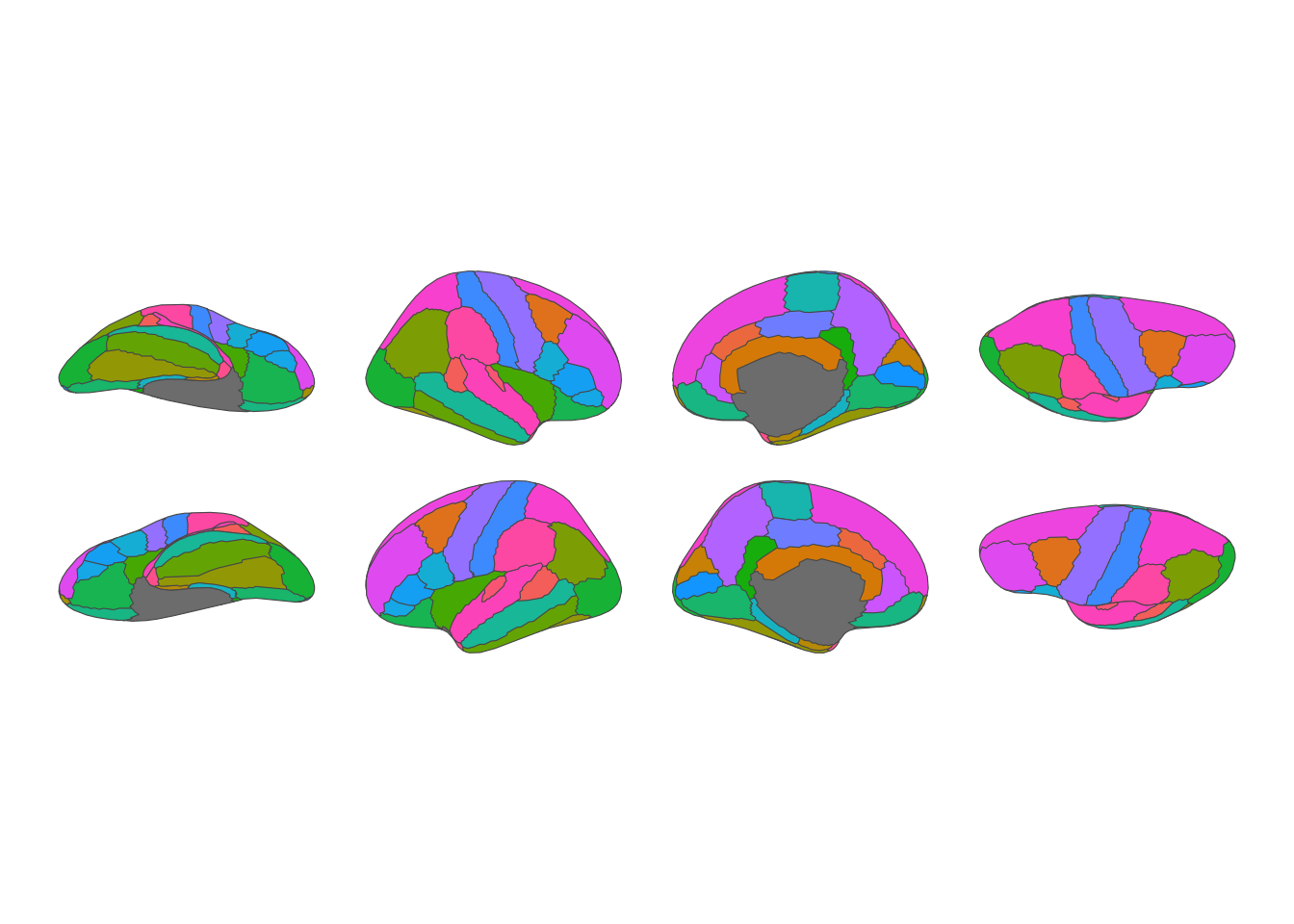
The Desikan-Killiany atlas drawn with geom_brain() — exact same code as before, now rendered without sf.
That’s the same geom_brain() you’ve always written, producing the same figure it always has — only now there’s no sf underneath it. position_brain() and annotate_brain() are unchanged too. If you never thought about sf while using ggseg, you can keep not thinking about it, and your installs just got a lot less fragile.
Why sf was the sticking point
To draw a brain region, ggseg needs the polygon that traces its outline. Historically those polygons lived in sf objects, which meant that simply holding the data pulled in the whole geospatial stack.
That stack is wonderful when you’re doing real GIS work. For ggseg, though, we were paying a steep installation cost for a fraction of what sf offers — we mostly just needed to store coordinates and hand them to geom_polygon().
The problem shows up hardest in three places:
Locked-down systems. Corporate and clinical machines where you can’t apt install libgdal-dev, and IT isn’t going to do it for you.
HPC clusters. Where the system libraries exist but are the wrong version, or compiling them eats an afternoon you didn’t have.
WebAssembly. Tools like webR and shinylive run R entirely in the browser — no server, no install — but they can’t build GDAL/GEOS/PROJ at all. sf simply doesn’t go there.
That last case is genuinely new — every earlier version of ggseg was locked out of the browser by sf. With sf off the hard-dependency path, ggseg should finally run there — think live teaching materials, interactive documentation, and demos where a student plots a brain without installing a single thing.
What we actually changed
Under the hood, atlas geometry now has two possible homes, and they convert between each other losslessly:
A new brain_polygons representation — a tidy nested table of region coordinates that geom_polygon() can draw directly.
The familiar sf representation, for when you have sf and want the full geospatial toolkit.
The conversion between them uses sfheaders, which is pure C++ (Rcpp) with no system-library baggage. So sfheaders joins the hard dependencies, and sf moves from Imports to Suggests in both ggseg and ggseg.formats. The geometry round-trips perfectly, so nothing is lost — the polygon path and the sf path describe the same brains down to the coordinate.
Reaching into the geometry
Two representations raises a fair question: how do you tell which one an atlas is carrying, and how do you get the geometry out — without rummaging through atlas$data yourself?
There’s a small set of accessors for exactly that. atlas_geometry_type() reports which representation an atlas holds, with is_atlas_sf() and is_atlas_polygon() as the quick yes/no versions. atlas_polygons() hands you the polygon table — no sf required — and atlas_sf() hands you the sf geometry, converting from polygons on the fly when that’s all the atlas has.
library(ggseg.formats)atlas_geometry_type(dk())
[1] "polygon"
is_atlas_polygon(dk())
[1] TRUE
polys <-atlas_polygons(dk())
If you write code on top of ggseg — an atlas package, an analysis pipeline, anything that touches atlas geometry — reach for these accessors rather than the internal atlas$data slots. They keep working whichever representation an atlas ships, now or after it migrates, and they’re the boundary we actually maintain.
When you do want sf
Optional doesn’t mean gone. If you’ve installed sf, everything it gave you is still there — you just opt in.
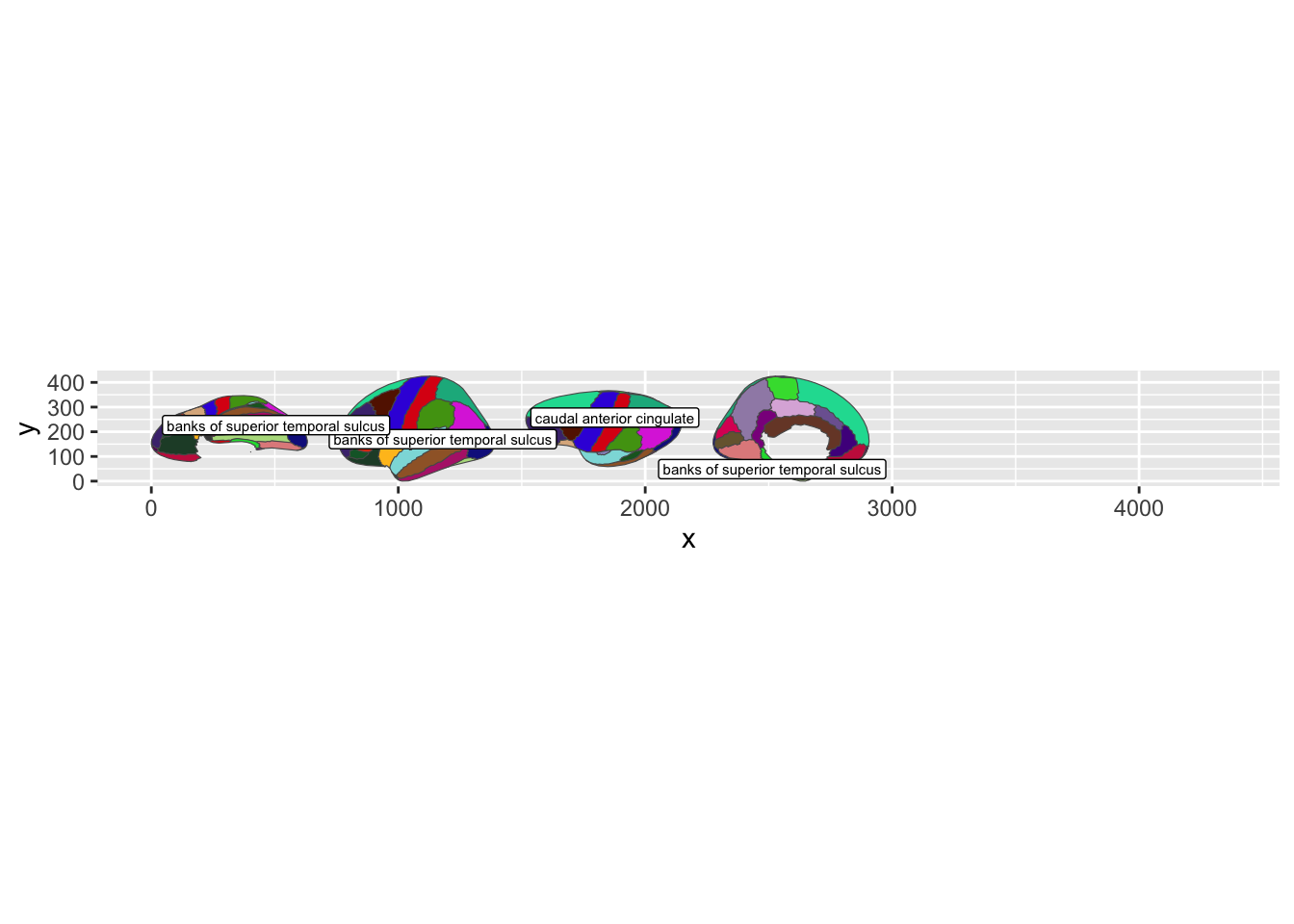
The most common reason to reach for it is layering other sf geoms on top of a brain, like adding region labels:
library(sf)
Linking to GEOS 3.13.0, GDAL 3.8.5, PROJ 9.5.1; sf_use_s2() is TRUE
Warning: Removed 6 rows containing missing values or values outside the scale range
(`geom_label()`).
as_sf_atlas() converts any atlas to its sf form on demand, and from there you’re back in full ggplot2::geom_sf() territory. There’s a vignette("geom-sf") walking through it if you want the details.
A note on the sf-backed geoms
The old sf-specific drawing functions, geom_brain_sf() and position_brain_sf(), are there to give you the same plot as before using sf, but are deprecated. They’ll stick around for a transition period and then be removed in a future release.
If you maintain an atlas package
This is the one group that needs to do a little work. The bundled atlases (dk(), aseg(), tracula(), suit()) already ship in the new format, so they need sf for nothing. But if you maintain one of the many ggseg* atlas packages, your data/*.rda files still carry sf geometry — which means a user without sf installed can’t draw your atlas yet.
Migrating is genuinely a three-line job. ggseg.formats ships a helper and a dedicated guide:
library(ggseg.formats)migrate_atlas_files("data")
vignette("migrating-atlases") in ggseg.formats walks through the whole recipe. Once you’ve migrated and re-released, your atlas installs and plots on the same wasm-and-locked-down systems the core packages now reach. If a user does hit a still-sf-backed atlas on a machine without sf, ggseg.formats now errors with a clear message pointing them (and you) straight at migrate_atlas_files(), instead of a cryptic “sf is required”.
The bigger picture
We build ggseg so people can show their brain data without fighting their tools. A dependency that fails to compile is the most frustrating kind of barrier — you haven’t even started your analysis and you’re already stuck.
Making sf optional pulls that barrier out of the way for the people who hit it hardest: students on managed laptops, researchers on clusters, and anyone who wants to teach or demo ggseg in a browser tab. And it does it without asking the rest of you to change a single line.
If you install ggseg somewhere it never used to work — a wasm notebook, a stubborn cluster, a laptop you don’t have admin on — we’d love to hear about it. Open a discussion or file an issue if anything behaves unexpectedly.