
Tract atlases represent white matter pathways derived from diffusion MRI tractography. Unlike cortical or subcortical atlases where regions are contiguous surfaces, tracts are tube-like structures that follow streamline bundles through the brain.
The pipeline reads tractography files, computes a centerline for each tract, wraps it in a tube mesh, and (optionally) creates 2D projection views.
This tutorial recreates the TRACULA atlas — the same pipeline behind data-raw/make_tracula_atlas.R in ggseg.formats.
What you need
- FreeSurfer installed with TRACULA training data (
trctrain/)
Finding tractography files
TRACULA training data ships with FreeSurfer in the trctrain/ directory. Each .trk file contains streamlines for one tract:
fs_dir <- freesurfer::fs_dir()
tract_dir <- file.path(fs_dir, "trctrain", "hcp", "mgh_1017", "mni")

tract_files <- list.files(tract_dir, pattern = "\\.trk$", full.names = TRUE)
aseg_file <- file.path(tract_dir, "aparc+aseg.nii.gz")

length(tract_files)
#> [1] 42
The aparc+aseg.nii.gz provides cortex outlines for 2D projections. If it’s missing, you can still create a 3D-only atlas.
Creating the atlas
create_tract_from_tractography() reads each tractography file, computes a centerline, and generates a tube mesh around it. The input_aseg provides cortex context for 2D views:
tracula_raw <- create_tract_from_tractography(
  input_tracts = tract_files,
  input_aseg = aseg_file,
  atlas_name = "tracula"
)
#> Warning: Atlas has 58862 vertices (threshold: 10000)
#> ℹ Large atlases may be slow to plot and increase package size
#> ℹ Call `atlas_simplify(atlas, keep = 0.2)`, then `atlas_smooth(atlas)`, to tidy
#>   it and reduce vertices

tracula_raw
#>
#> ── tracula ggseg atlas ─────────────────────────────────────────────────────────
#> Type: tract
#> Regions: 26
#> Hemispheres: midline, left, right
#> Views: axial_1, axial_2, axial_3, axial_4, axial_5, coronal_1, coronal_2,
#> coronal_3, coronal_4, coronal_5, coronal_6, sagittal_midline, sagittal_left,
#> sagittal_right
#> Palette: ✖
#> Rendering: ✔ ggseg
#> ✔ ggseg3d (centerlines)
#> ────────────────────────────────────────────────────────────────────────────────
#>       hemi               region                label
#> 1  midline       acomm.bbr.prep       acomm.bbr.prep
#> 2  midline    cc.bodyc.bbr.prep    cc.bodyc.bbr.prep
#> 3  midline    cc.bodyp.bbr.prep    cc.bodyp.bbr.prep
#> 4  midline   cc.bodypf.bbr.prep   cc.bodypf.bbr.prep
#> 5  midline   cc.bodypm.bbr.prep   cc.bodypm.bbr.prep
#> 6  midline    cc.bodyt.bbr.prep    cc.bodyt.bbr.prep
#> 7  midline     cc.genu.bbr.prep     cc.genu.bbr.prep
#> 8  midline  cc.rostrum.bbr.prep  cc.rostrum.bbr.prep
#> 9  midline cc.splenium.bbr.prep cc.splenium.bbr.prep
#> 10    left          af.bbr.prep       lh.af.bbr.prep
#> ... with 32 more rows
plot(tracula_raw)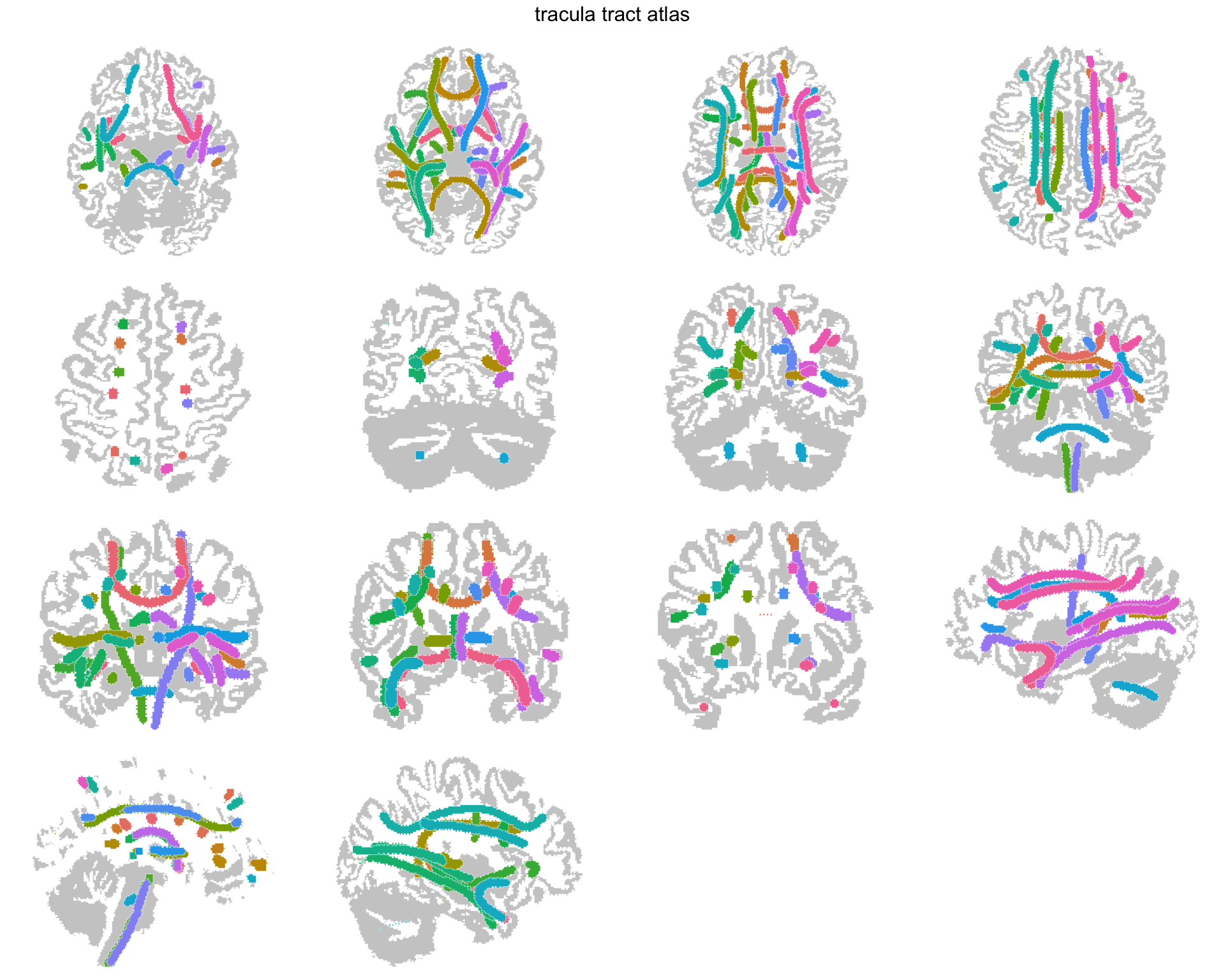
Stage 1 — every tract on every view the pipeline made.
Key parameters, all passed together in tube_opts:
-
tube_radiuscontrols tube thickness. Larger values make tracts more visible at the cost of anatomical precision. It also takes"density", to scale thickness by how many streamlines pass through each point. -
tube_segmentscontrols the number of vertices around the tube circumference. Six gives hexagonal cross-sections; 12+ gives smoother tubes. -
n_pointscontrols centerline resolution. More points capture finer curvature.
create_tract_from_tractography(
  input_tracts = tract_files,
  input_aseg = aseg_file,
  atlas_name = "tracula",
  tube_opts = list(tube_radius = 3, tube_segments = 12)
)
Post-processing
Selecting views
Keep the projections that show your tracts best:
tracula_raw <- tracula_raw |>
  atlas_view_keep(c(
    "axial_2",
    "axial_4",
    "coronal_3",
    "coronal_4",
    "sagittal"
  ))
plot(tracula_raw)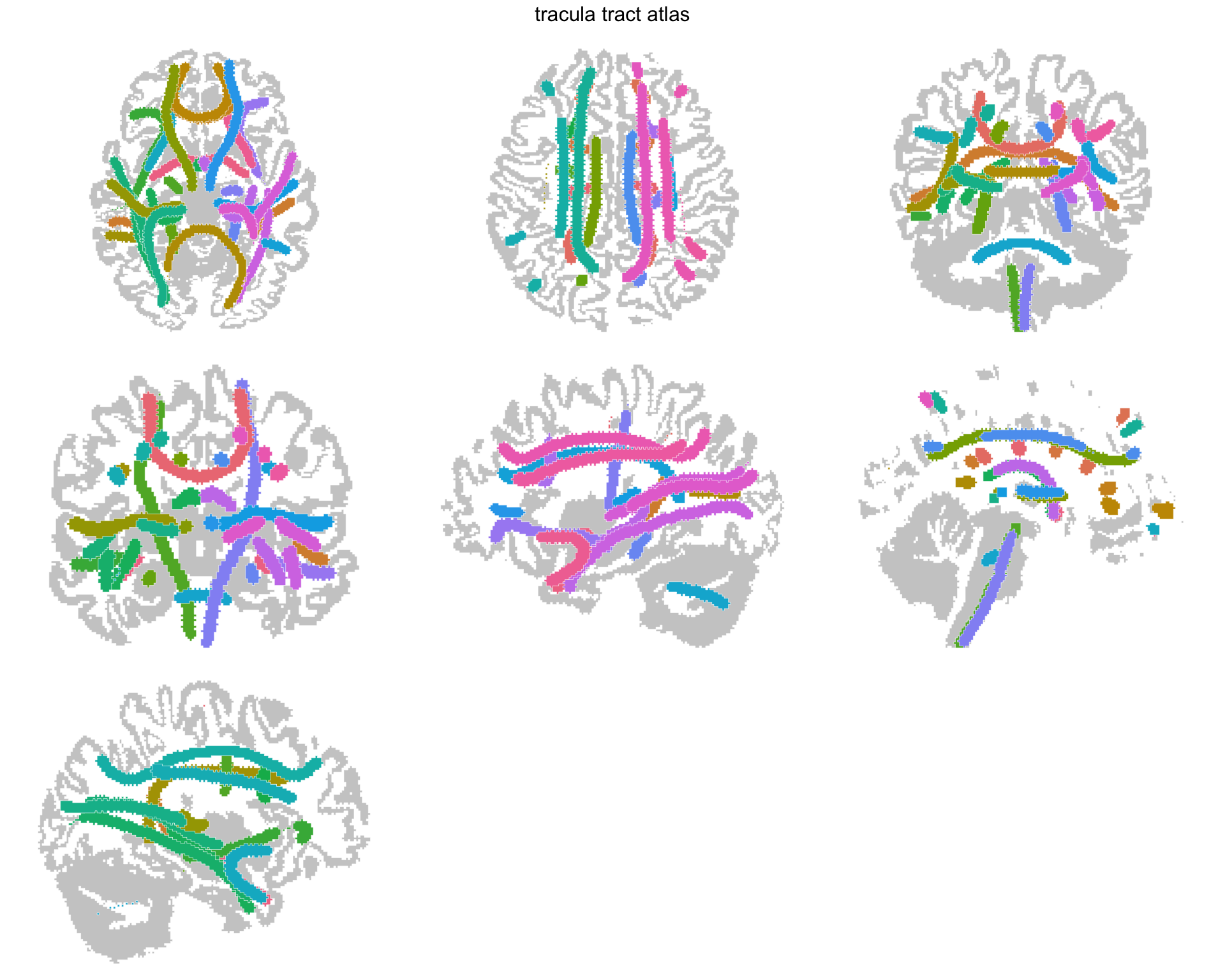
Stage 2 — down to the seven views that show the tracts; the sagittal pattern keeps all three.
Setting context regions
Add cortex as a background outline:
tracula_raw <- tracula_raw |>
  atlas_region_contextual("cortex", match_on = "label")
Removing small fragments
After view selection, some tracts may appear as tiny slivers in certain views. Remove fragments below a minimum area:
tracula_raw <- tracula_raw |>
  atlas_view_remove_small(
    min_area = 500,
    views = c("axial", "coronal")
  ) |>
  atlas_view_remove_small(min_area = 50)
#> ℹ Removed 98 geometries below area 500
#> ℹ Removed 12 geometries below area 50
plot(tracula_raw)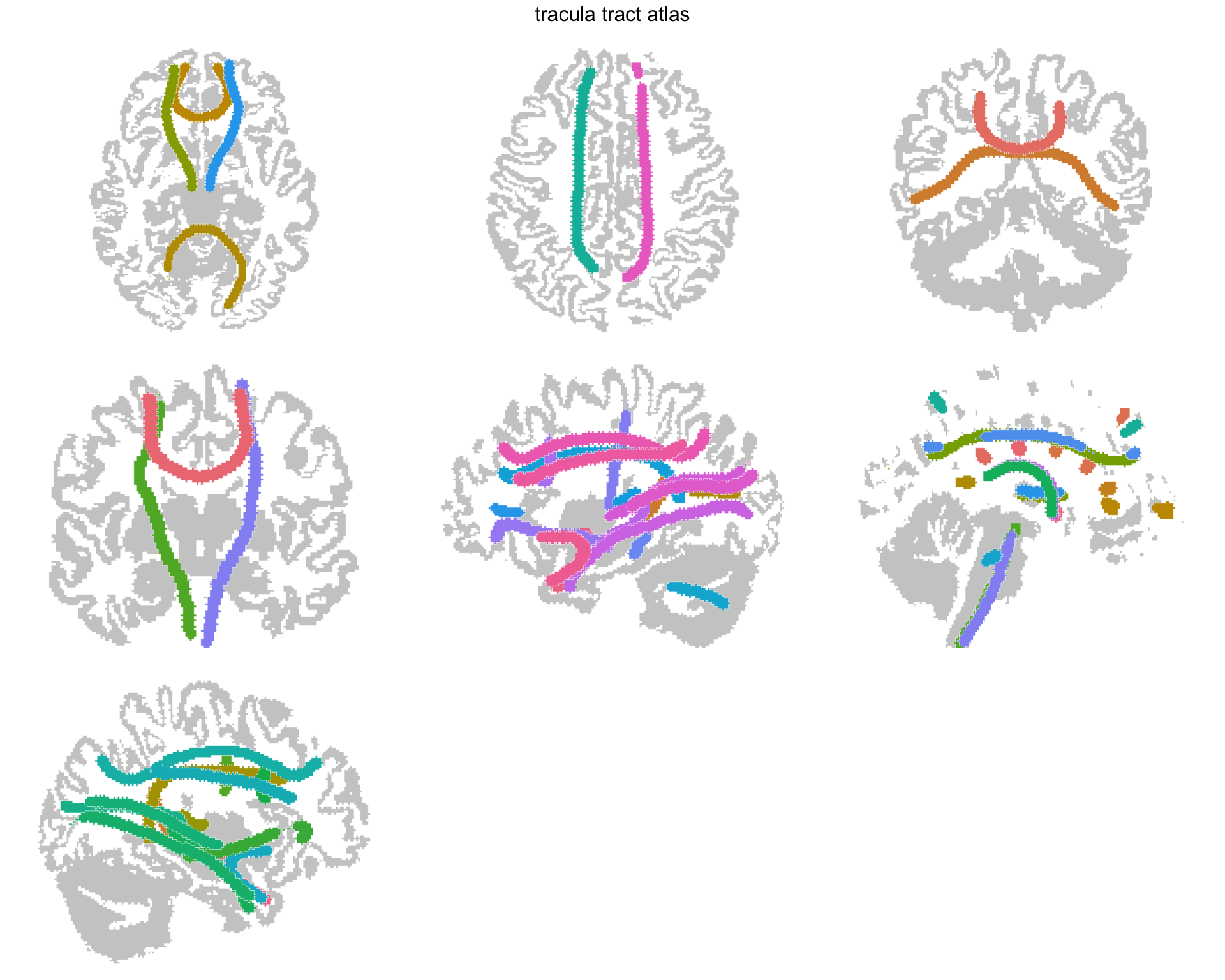
Stage 3 — the specks are gone.
The specks were real geometry — a tract crossing an axial slab leaves a dot where it passes through — but a dot carries no shape and reads as noise, so dropping them costs nothing and quiets the figure considerably.
The first call applies a higher threshold to axial and coronal views (where tracts appear in cross-section and produce small dots). The second call applies a lower threshold everywhere to catch remaining slivers.
Tidying the geometry
The tube outlines are still traced from mesh triangles, so every tract edge is a staircase. count_vertices() gives the price, and says where it is being paid:
vertices <- count_vertices(tracula_raw)

sum(vertices)
#> [1] 26545
sum(vertices[grepl(context_pattern(), names(vertices))])
#> [1] 18673
Most of the atlas is the cortex silhouette rather than the tracts, which is worth knowing before tuning anything: the create_*() functions warn above ten thousand vertices, and on a tract atlas the context is usually the reason.
Tidying is a separate post-processing step in two parts — atlas_simplify() drops vertices, atlas_smooth() rounds off what is left — and both are applied twice, because the context and the tracts want different things. The silhouette is only useful while its sulci survive, so it needs gentle settings; the tubes can take firmer ones.
Simplify each separately:
tracula_raw <- tracula_raw |>
  atlas_simplify(keep = 0.5, labels = context_pattern) |>
  atlas_simplify(keep = 0.3, exclude = context_pattern)

sum(count_vertices(tracula_raw))
#> [1] 14927
Simplification is topology-aware, so neighbouring geometries lose the same vertices and no gaps open between them. Keep an eye on the tracts as you lower keep: a tube cross-section is a small ring to begin with, and there is a point below which it stops reading as a tube and starts reading as a polygon.
Then smooth each separately, and note the second argument:
tracula_raw <- tracula_raw |>
  atlas_smooth(
    smoothness = 0.35,
    labels = context_pattern,
    method = "chaikin"
  ) |>
  atlas_smooth(smoothness = 0.4, exclude = context_pattern)

sum(count_vertices(tracula_raw))
#> [1] 16191
plot(tracula_raw)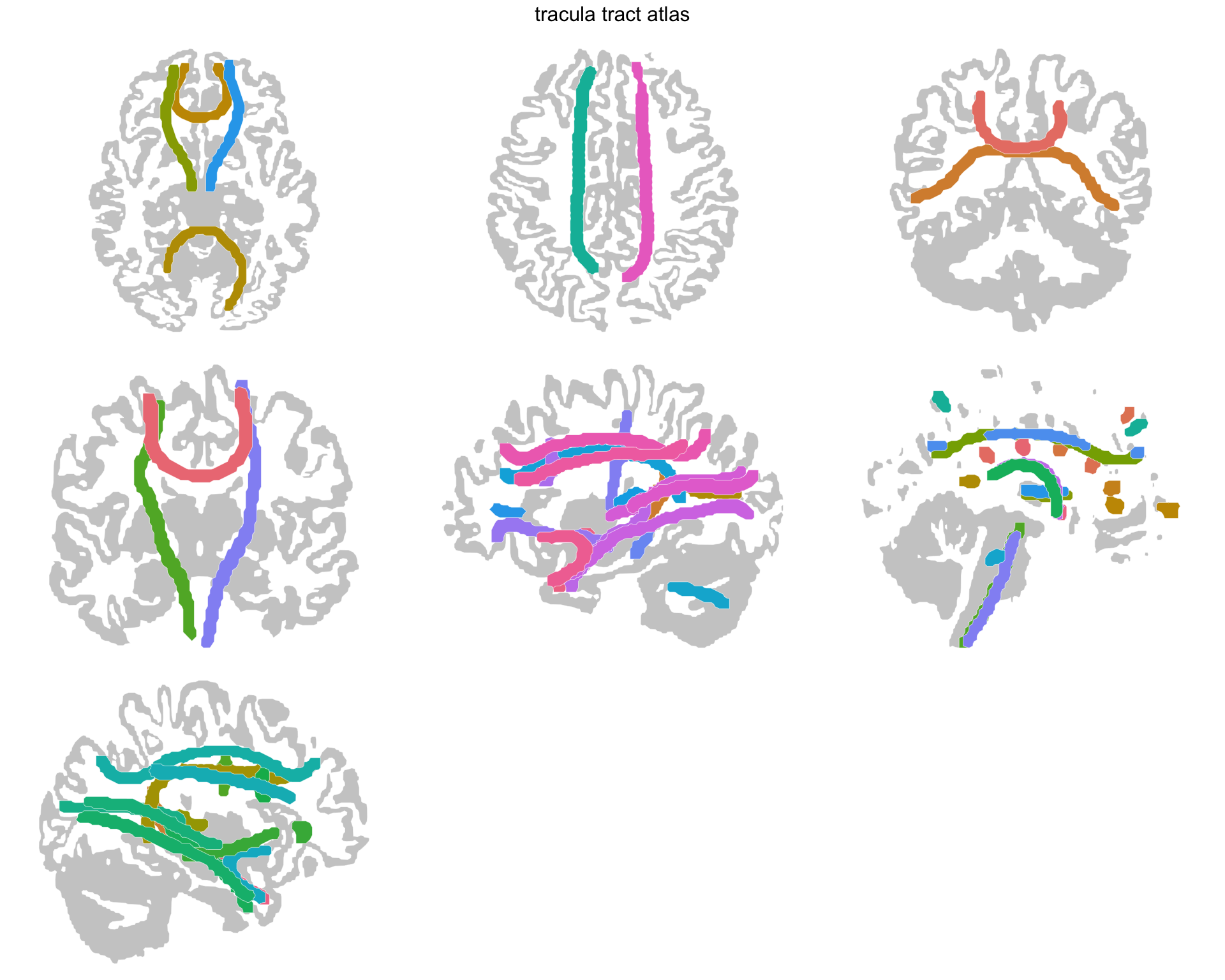
Stage 4 — simplified and smoothed. The tube edges are clean and the silhouette still has its folds.
method = "chaikin" is not optional for the context. The default close dilates and then erodes, which fills any hole narrower than the smoothing distance — on a cortex silhouette those holes are the sulci, so the default destroys exactly what the context is for. Chaikin’s corner-cutting preserves rings instead.
Notice that the count went back up. Smoothing is not a reduction step: chaikin subdivides each corner it cuts, and close resamples what it traces. Simplify to set the budget, smooth to set the look, and read the total after both rather than after either.
This atlas stays heavy even so — forty-two tracts across seven views, each with its own silhouette, is a lot of geometry. If the total matters more than the coverage, the levers are the same ones used above: fewer views, or fewer tracts.
Adding metadata
Join tract group information — which tracts are commissural, which are projection fibres, which are association:
tracula_metadata <- data.frame(
  label = c(
    "lh.cst.bbr.prep", "rh.cst.bbr.prep",
    "lh.ilf.bbr.prep", "rh.ilf.bbr.prep",
    "lh.uf.bbr.prep", "rh.uf.bbr.prep",
    "lh.atr.bbr.prep", "rh.atr.bbr.prep",
    "acomm.bbr.prep",
    "cc.genu.bbr.prep", "cc.rostrum.bbr.prep", "cc.splenium.bbr.prep",
    "cc.bodyc.bbr.prep", "cc.bodyp.bbr.prep", "cc.bodypf.bbr.prep",
    "cc.bodypm.bbr.prep", "cc.bodyt.bbr.prep"
  ),
  region_pretty = c(
    "corticospinal tract", "corticospinal tract",
    "inferior longitudinal fasciculus", "inferior longitudinal fasciculus",
    "uncinate fasciculus", "uncinate fasciculus",
    "anterior thalamic radiation", "anterior thalamic radiation",
    "anterior commissure",
    "callosal genu", "callosal rostrum", "callosal splenium",
    "callosal body (central)", "callosal body (posterior)",
    "callosal body (prefrontal)", "callosal body (premotor)",
    "callosal body (temporal)"
  ),
  group = c(
    "projection", "projection",
    "association", "association",
    "association", "association",
    "projection", "projection",
    "commissural",
    "commissural", "commissural", "commissural",
    "commissural", "commissural", "commissural", "commissural",
    "commissural"
  )
)

core_with_meta <- tracula_raw$core |>
  left_join(tracula_metadata, by = "label") |>
  mutate(region = coalesce(region_pretty, region)) |>
  select(hemi, region, label, group)
Rebuilding and saving
tracula <- ggseg_atlas(
  atlas = "tracula",
  type = "tract",
  palette = tracula_raw$palette,
  core = core_with_meta,
  data = tracula_raw$data
)

tracula
#>
#> ── tracula ggseg atlas ─────────────────────────────────────────────────────────
#> Type: tract
#> Regions: 26
#> Hemispheres: midline, left, right
#> Views: axial_2, axial_4, coronal_3, coronal_4, sagittal_midline, sagittal_left,
#> sagittal_right
#> Palette: ✖
#> Rendering: ✔ ggseg
#> ✔ ggseg3d (centerlines)
#> ────────────────────────────────────────────────────────────────────────────────
#>       hemi                     region                label       group
#> 1  midline        anterior commissure       acomm.bbr.prep commissural
#> 2  midline    callosal body (central)    cc.bodyc.bbr.prep commissural
#> 3  midline  callosal body (posterior)    cc.bodyp.bbr.prep commissural
#> 4  midline callosal body (prefrontal)   cc.bodypf.bbr.prep commissural
#> 5  midline   callosal body (premotor)   cc.bodypm.bbr.prep commissural
#> 6  midline   callosal body (temporal)    cc.bodyt.bbr.prep commissural
#> 7  midline              callosal genu     cc.genu.bbr.prep commissural
#> 8  midline           callosal rostrum  cc.rostrum.bbr.prep commissural
#> 9  midline          callosal splenium cc.splenium.bbr.prep commissural
#> 10    left                af.bbr.prep       lh.af.bbr.prep        <NA>
#> ... with 32 more rows
atlas_labels(tracula)
#>  [1] "acomm.bbr.prep"       "cc.bodyc.bbr.prep"    "cc.bodyp.bbr.prep"
#>  [4] "cc.bodypf.bbr.prep"   "cc.bodypm.bbr.prep"   "cc.bodyt.bbr.prep"
#>  [7] "cc.genu.bbr.prep"     "cc.rostrum.bbr.prep"  "cc.splenium.bbr.prep"
#> [10] "lh.af.bbr.prep"       "lh.ar.bbr.prep"       "lh.atr.bbr.prep"
#> [13] "lh.cbd.bbr.prep"      "lh.cbv.bbr.prep"      "lh.cst.bbr.prep"
#> [16] "lh.emc.bbr.prep"      "lh.fat.bbr.prep"      "lh.fx.bbr.prep"
#> [19] "lh.ilf.bbr.prep"      "lh.mlf.bbr.prep"      "lh.or.bbr.prep"
#> [22] "lh.slf1.bbr.prep"     "lh.slf2.bbr.prep"     "lh.slf3.bbr.prep"
#> [25] "lh.uf.bbr.prep"       "mcp.bbr.prep"         "rh.af.bbr.prep"
#> [28] "rh.ar.bbr.prep"       "rh.atr.bbr.prep"      "rh.cbd.bbr.prep"
#> [31] "rh.cbv.bbr.prep"      "rh.cst.bbr.prep"      "rh.emc.bbr.prep"
#> [34] "rh.fat.bbr.prep"      "rh.fx.bbr.prep"       "rh.ilf.bbr.prep"
#> [37] "rh.mlf.bbr.prep"      "rh.or.bbr.prep"       "rh.slf1.bbr.prep"
#> [40] "rh.slf2.bbr.prep"     "rh.slf3.bbr.prep"     "rh.uf.bbr.prep"

table(tracula$core$group, useNA = "ifany")
#>
#> association commissural  projection        <NA>
#>           4           9           4          25
The table above covers the tracts this training set names unambiguously; the rest keep their raw labels and an NA group. Note the join key is the label exactly as the pipeline wrote it, .bbr.prep and all — strip the extension first and nothing matches, silently.
ggplot2::ggplot() +
  ggseg::geom_brain(atlas = tracula, ggplot2::aes(fill = region)) +
  ggplot2::scale_fill_viridis_d(na.value = "grey80") +
  ggplot2::theme_void()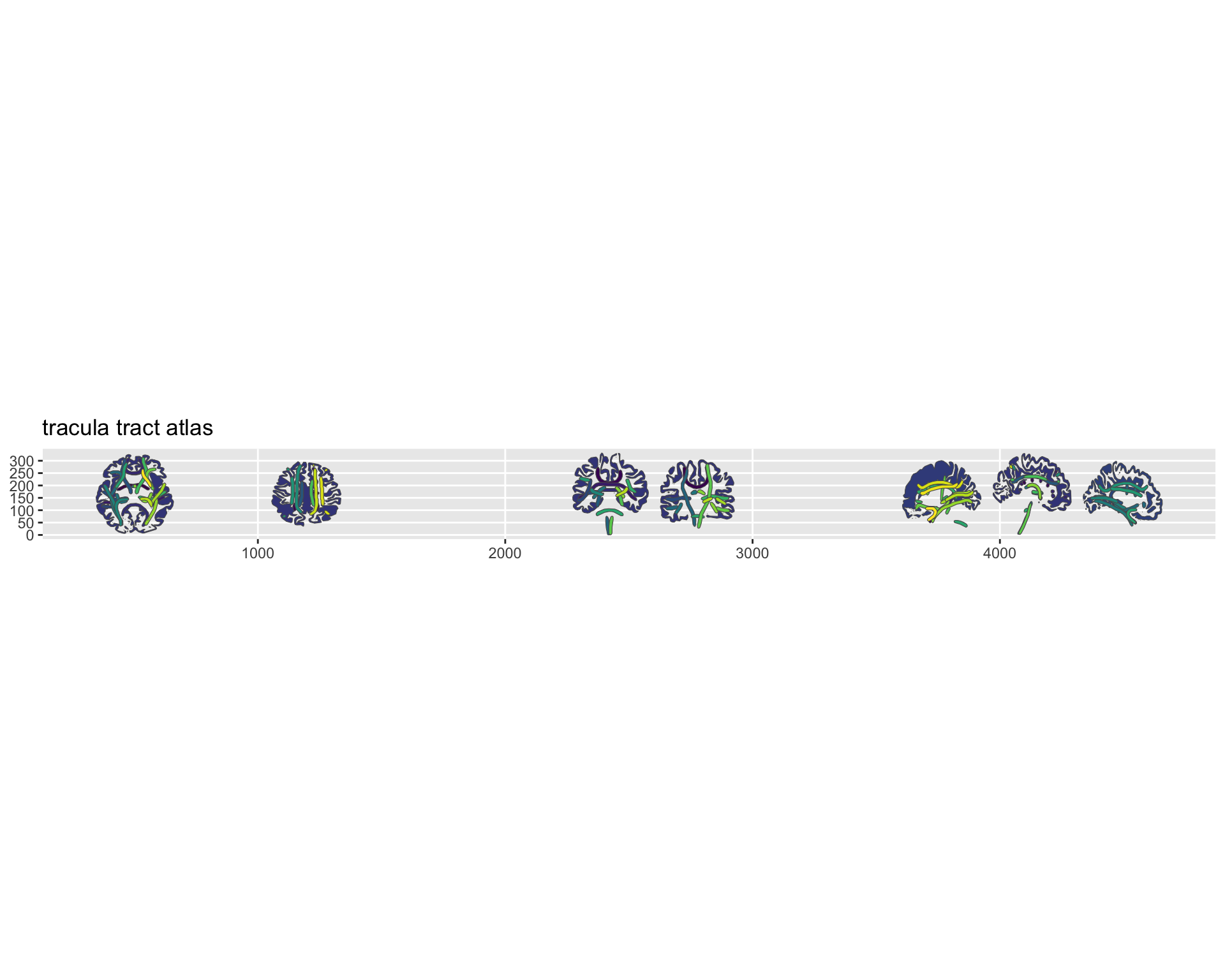
Stage 5 — the finished atlas, drawn through ggplot2 with a viridis fill.
plot() is the quick look, using the atlas’s own palette. geom_brain() is the route when you want to control the colours — map something to fill, or a fill scale has nothing to colour and every region comes back as na.value.